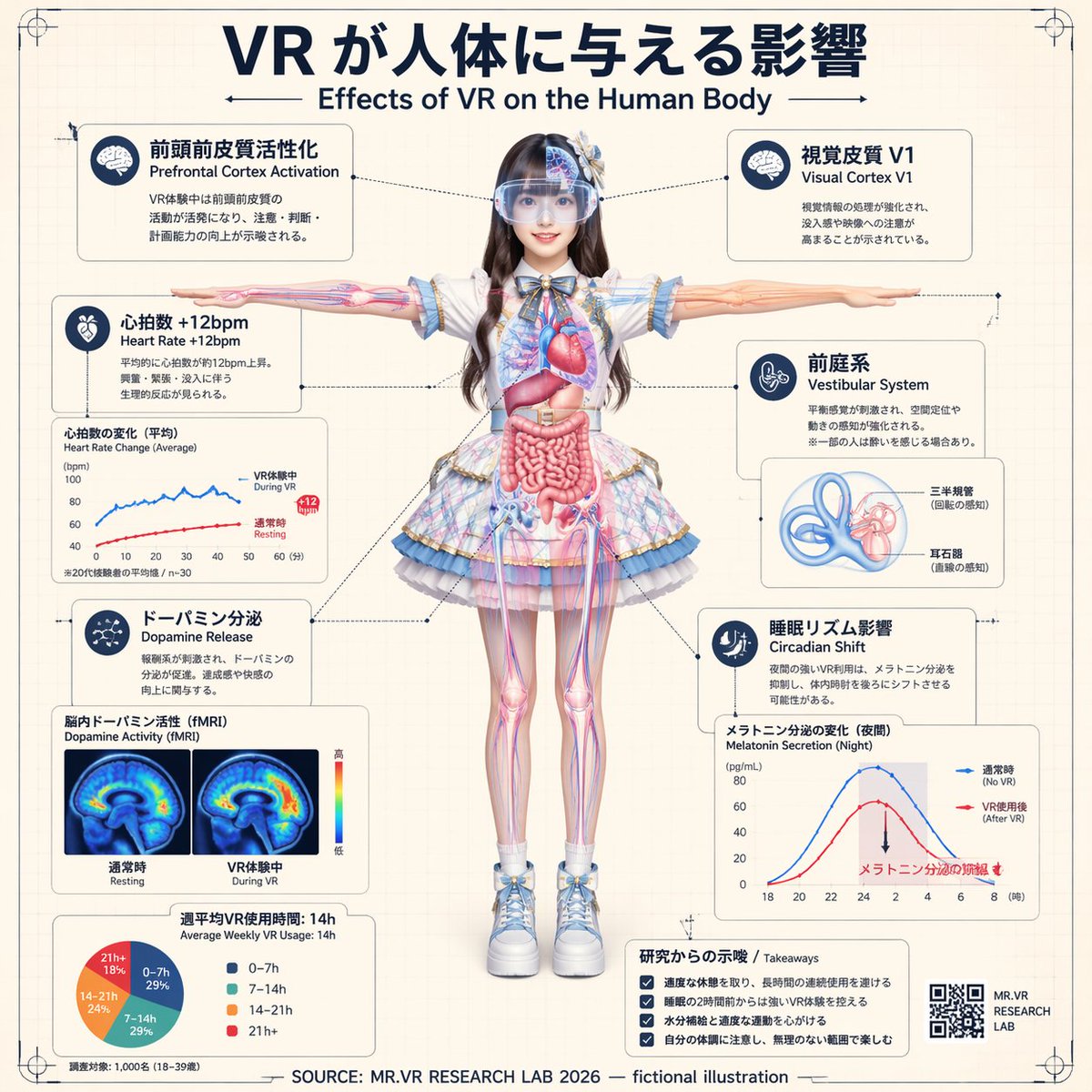
VR Effects on the Human Body Infographic
A bilingual Japanese-English scientific poster showing an anime girl with anatomical overlays and multiple charts, suitable for recreating educational VR health infographics.
This is a gpt-image-2 prompt case for Graphic & Poster. Use the copy-ready prompt below to generate similar visuals, and review YouMind OpenLab awesome-gpt-image-2 attribution plus commercial-use rights before reuse.
Prompt
Copy-ready prompt
{
  "type": "Medical Infographic Poster",
  "subject": "Front view of a full-body anime idol girl with semi-transparent anatomical overlays.",
  "style": {
    "overall": "A simple Japanese educational infographic that blends cute anime character art with scientific visualization.",
    "background": "The paper has a warm off-white tone with a subtle grid pattern.",
    "palette": "Navy blue, cream, soft pastel pink, pastel blue, medical red and blue",
    "rendering": "Highly detailed and exquisite poster design, clear vector UI frames, soft character shadows, and realistic anatomical illustrations composited onto the body."
  },
  "character": {
    "gender_presentation": "woman",
    "age_appearance": "Teenagers to young adults",
    "pose": "Stand upright with your body centered and arms extended horizontally to the sides.",
    "outfit": "A pastel idol dress with short puff sleeves, ruffled hem, layered skirt, blue ribbon bow at the neckline, lace trim, white ankle socks, and blue high-top sneakers.",
    "hair": {
      "color": "Dark brown",
      "style": "Long, wavy pigtails fall over her shoulders and extend below her chest, parted in the middle, and adorned with small decorative flower hair accessories."
    },
    "face": "Intentionally blurring/obscuring"
  },
  "anatomy_overlay": {
    "visible_parts_count": 8,
    "visible_parts": [
      "A head that glows",
      "Lungs and heart in the chest",
      "Abdominal digestive organs",
      "Glowing reproductive/urinary areas in the pelvis",
      "Arteries in both arms",
      "veins in both arms",
      "Arteries and veins in the legs",
      "Highlighted inner ear balance structures near the head"
    ]
  },
  "layout": {
    "title_block": {
      "count": 2,
      "lines": [
        "The effects of VR on the human body",
        "The effects of VR on the human body"
      ],
      "position": "Centered at the top"
    },
    "main_centerpiece": "The character is depicted in a T-shape, marked with dotted lines, connecting various body parts to surrounding information boxes.",
    "info_boxes": {
      "count": 6,
      "items": [
        {
          "title": "Precortical activation",
          "subtitle": "Prefrontal cortex activation",
          "position": "Top left",
          "icon": "brain"
        },
        {
          "title": "Visual cortex V1",
          "subtitle": "Visual cortex V1",
          "position": "Top right",
          "icon": "brain"
        },
        {
          "title": "Heart rate +12 bpm",
          "subtitle": "Heart rate +12 bpm",
          "position": "Top left center",
          "icon": "heart"
        },
        {
          "title": "vestibular system",
          "subtitle": "vestibular system",
          "position": "Right Center",
          "icon": "head and balance"
        },
        {
          "title": "Dopamine secretion",
          "subtitle": "Dopamine secretion",
          "position": "Left center bottom",
          "icon": "molecule/network"
        },
        {
          "title": "Influence on sleep rhythm",
          "subtitle": "circadian rhythm shift",
          "position": "Right center bottom",
          "icon": "moon and stars"
        }
      ]
    },
    "charts": {
      "count": 4,
      "items": [
        {
          "title": "Heart rate changes (average)",
          "subtitle": "Heart rate variability (average)",
          "position": "Left center bottom",
          "chart_type": "Line graph with blue and red lines",
          "labels": [
            "VR experience",
            "Normal state",
            "+12"
          ]
        },
        {
          "title": "Brain dopamine activity (fMRI)",
          "subtitle": "Brain dopamine activity (fMRI)",
          "position": "Bottom left",
          "chart_type": "Two brain scans with color-coded scales",
          "labels": [
            "Normal state",
            "VR experience",
            "resting state",
            "VR period"
          ]
        },
        {
          "title": "Changes in melatonin secretion (at night)",
          "subtitle": "Changes in melatonin secretion (at night)",
          "position": "Bottom right",
          "chart_type": "Line graph with blue and red curves",
          "labels": [
            "Normal state",
            "After watching VR",
            "No VR",
            "VR after",
            "Melatonin secretion is suppressed"
          ]
        },
        {
          "title": "Average weekly VR usage time: 14 hours",
          "subtitle": "Average weekly VR usage time: 14 hours",
          "position": "Bottom left",
          "chart_type": "Pie chart",
          "labels": [
            "0–7 hours",
            "7–14 hours",
            "14–21 hours",
            "21 hours+"
          ]
        }
      ]
    },
    "diagrams": {
      "count": 1,
      "items": [
        {
          "title": "Inner ear balance chart",
          "position": "Lower right, near the vestibular system frame",
          "labels": [
            "Tripartite canal",
            "Otoliths"
          ]
        }
      ]
    },
    "research_box": {
      "count": 1,
      "position": "Bottom Middle Right",
      "title": "Research Implications / Takeaways",
      "bullet_count": 4
    },
    "branding": {
      "count": 3,
      "items": [
        "Source: MR.VR RESEARCH LAB 2026",
        "MR.VR RESEARCH LAB",
        "QR code in the bottom right corner"
      ]
    },
    "border": "The edges feature a decorative technical border, with corner accents and small, measurement-mark-like scales."
  },
  "text_density": "High, the full text includes English and Japanese subheadings.",
  "composition": "The poster is symmetrical, with labels on both sides of the characters, a chart fixed in the bottom corner, and a prominent, bold title at the top.",
  "quality": "Clear, suitable for publication, square format"
}
Reuse and source notes
Use this prompt safely after previewing the case.
- 1.Copy the prompt or open it directly in Dovoo with the generation button.
- 2.Adjust variables, aspect ratio, and reference images for your own use case.
- 3.Before publishing or paid usage, verify source rights, attribution requirements, and brand or likeness risks.
Can I use this prompt commercially?
Commercial-use status is unknown. Review the original source, license, brand constraints, and legal requirements before paid usage.
Where does this case come from?
This case is imported from YouMind OpenLab awesome-gpt-image-2; keep attribution visible and check the source URL before reuse.