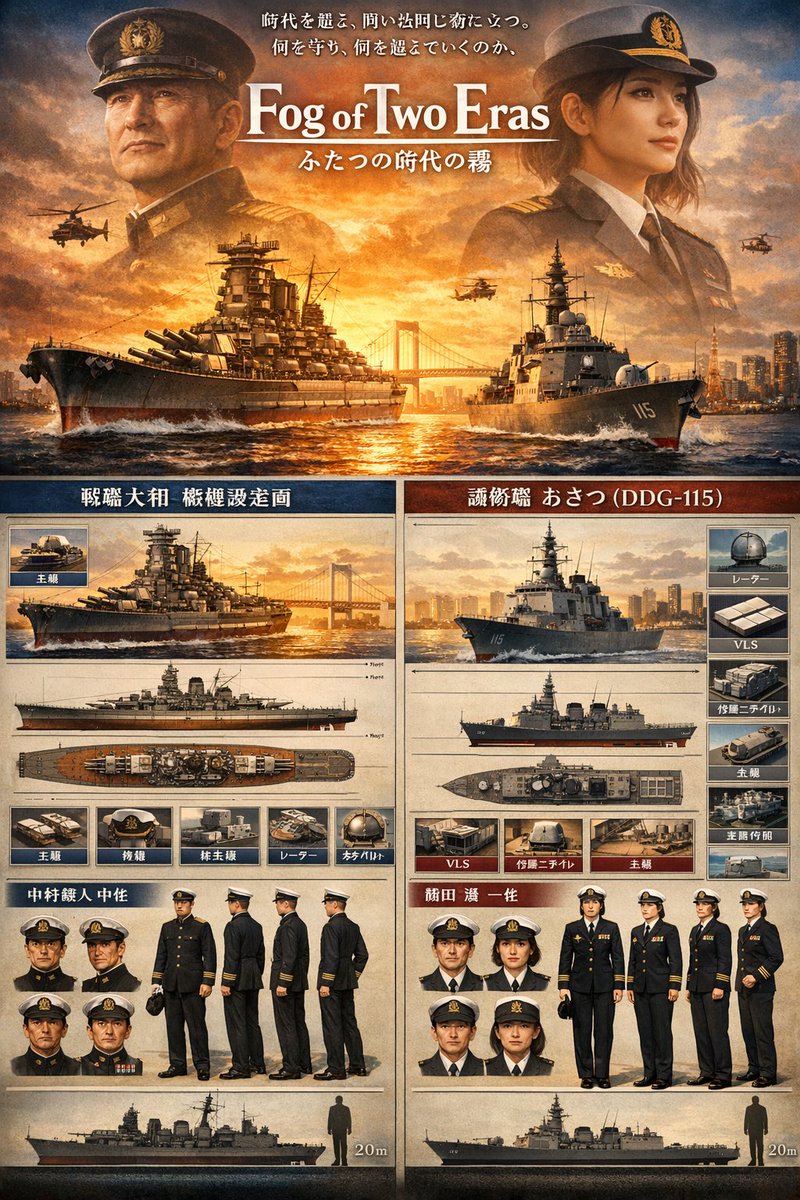
Two-Era Naval Comparison Poster
A cinematic Japanese military-style poster comparing a WWII battleship and a modern destroyer, ideal for presentation covers, history visuals, or dramatic concept key art.
This is a gpt-image-2 prompt case for Graphic & Poster. Use the copy-ready prompt below to generate similar visuals, and review YouMind OpenLab awesome-gpt-image-2 attribution plus commercial-use rights before reuse.
Prompt
Copy-ready prompt
Create a cinematic Japanese naval contrast poster, employing a highly detailed, realistic conceptual art style. The color palette is a warm amber sunset, complemented by dramatic clouds, luminous backlighting, and a layout combining a high-quality cinematic poster with technical reference tables. The composition is divided vertically into two main areas. At the top, in the "Heroes" section, display two large, semi-transparent portraits of officers turned inwards. The left officer wears a navy uniform from the old imperial era, while the right officer wears a modern Maritime Self-Defense Force-style dress uniform. Both wear peaked caps and dark dress coats against a backdrop of a vibrant sunset sky. A large serif English title is placed centered between the two figures.{argument name="headline text" default="Fog of Two Eras"} Below is a smaller Japanese subtitle, "Futatsu no Jidai no Kū" (The Fog of the Ages), with two lines of Japanese text above it. Below the title, on the sea at its prime, two warships are shown sailing forward, their course slightly converging: on the left is a massive World War II battleship with numerous large turrets, a tower-like superstructure, a weathered dark hull, and white bow spray; on the right is a modern gray guided-missile destroyer, its hull number 115 visible at the bow, featuring a streamlined radar superstructure and foamy wakes. Four helicopters are added to the sky, two on each side, with a suspension bridge and a distant modern city skyline above the horizon. The reference table area below divides the page into two vertical panels: the left for historical ships and the right for modern ships. Each panel is designed as a parchment-textured military specification item, with dark blue and dark red title bars, fine dividing lines, embedded image frames, and Japanese labels. The left panel should display a large perspective rendering of a battleship, three orthographic views of the ship below, a row of five small, tagged equipment/detail thumbnails, four small portraits of officers in uniform, four full-body rotating views of male naval officers, and a scaled silhouette of the ship and officers at the bottom (marked with 20 meters). The right panel should display a large perspective rendering of a modern destroyer, three orthographic views of the ship below, six small, tagged equipment/detail thumbnails arranged around the ship's reference image, four small portraits of officers in uniform, four full-body views of the formation (including a female officer wearing a white hat and dark uniform), and a scaled silhouette of the ship and officers at the bottom (marked with 20 meters). Prominent Japanese titles and labels should be used throughout, including the historical title area on the left and the title area on the right that names the ship "貴貴あさつ(DDG-115)". The image possesses the quality of a combination of museum exhibition posters, military design drawings, and key visuals from a high-quality historical science fiction drama, featuring ultra-clear details, realistic metallic textures, ocean reflections, aged paper panels, symmetrical balance, and exquisite typography.Prompt variables
Editable argument placeholders found in the prompt, with their default values.
Reuse and source notes
Use this prompt safely after previewing the case.
- 1.Copy the prompt or open it directly in Dovoo with the generation button.
- 2.Adjust variables, aspect ratio, and reference images for your own use case.
- 3.Before publishing or paid usage, verify source rights, attribution requirements, and brand or likeness risks.
Can I use this prompt commercially?
Commercial-use status is unknown. Review the original source, license, brand constraints, and legal requirements before paid usage.
Where does this case come from?
This case is imported from YouMind OpenLab awesome-gpt-image-2; keep attribution visible and check the source URL before reuse.