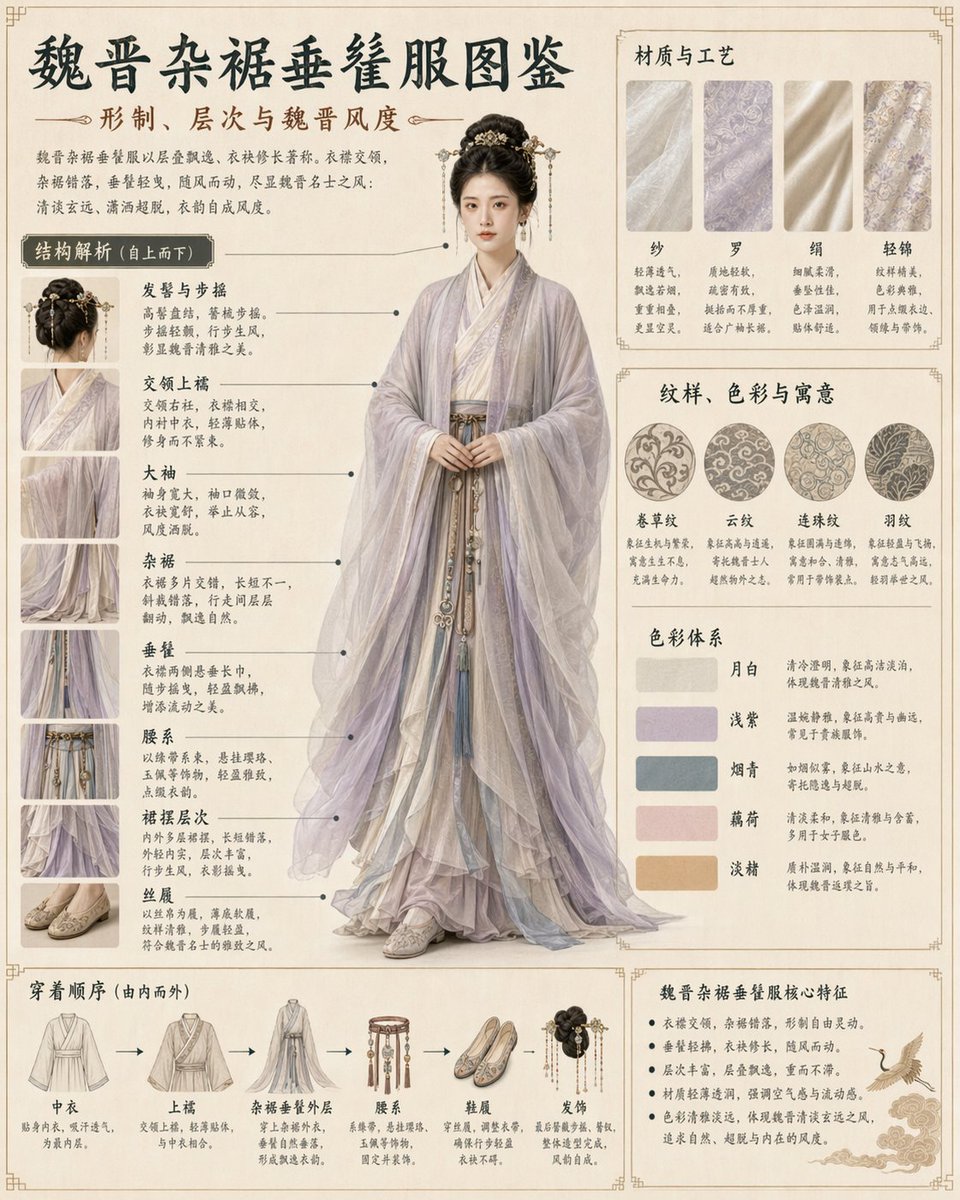
Traditional Clothing Infographic Guide
Generates a highly detailed, museum-quality infographic breaking down the structure, materials, and wearing sequence of traditional garments.
This is a gpt-image-2 prompt case for 平面海报. Use the copy-ready prompt below to generate similar visuals, and review YouMind OpenLab awesome-gpt-image-2 attribution plus commercial-use rights before reuse.
Prompt
Copy-ready prompt
{
  "type": "{argument name=\"aesthetic\" default=\"Elegant museum-quality infographics\"}",
  "theme": "Guide to Chinese Traditional Clothing",
  "header": {
    "title": "{argument name=\"main title\" default=\"A Pictorial Guide to Miscellaneous Wei and Jin Dynasty Garments with Hanging Sashes\"}",
    "subtitle": "Form, hierarchy and Wei-Jin style",
    "description": "An introductory paragraph about the elegant and flowing qualities of the clothing."
  },
  "centerpiece": {
    "subject": "{argument name=\"subject\" default=\"young Chinese women\"}",
    "clothing": "{argument name=\"clothing style\" default=\"Layered and flowing robes during the Wei and Jin Dynasties\"}",
    "colors": "{argument name=\"primary color\" default=\"Lilac purple and light blue\"}",
    "pose": "Elegant posture, hands clasped at the waist, full-body portrait",
    "details": "Exquisite hair accessories, flowing ribbons, and multi-layered skirts."
  },
  "layout": {
    "left_column": {
      "title": "Structural analysis (top to bottom)",
      "count": 8,
      "format": "Small square thumbnails with bold labels and descriptive text.",
      "labels": [
        "Hair bun and hair ornament",
        "Cross-collar upper garment",
        "large sleeves",
        "Miscellaneous hem",
        "drooping beard",
        "Waist belt",
        "Skirt layers",
        "Silk Shoes"
      ]
    },
    "top_right": {
      "title": "Materials and Craftsmanship",
      "count": 4,
      "format": "Fabric texture samples with labels and text",
      "labels": [
        "yarn",
        "Luo",
        "silk",
        "Light Brocade"
      ]
    },
    "middle_right": {
      "title": "Patterns, colors and symbolism",
      "patterns": {
        "count": 4,
        "format": "Circular pattern sample with label",
        "labels": [
          "scroll pattern",
          "cloud pattern",
          "beaded pattern",
          "Feather pattern"
        ]
      },
      "colors": {
        "count": 5,
        "format": "Rectangular color block samples with names and descriptions",
        "labels": [
          "Moon White",
          "Light purple",
          "Smoky Blue",
          "lotus",
          "light ochre"
        ]
      }
    },
    "bottom_left": {
      "title": "Dressing order (from inside to outside)",
      "count": 6,
      "format": "Clothing illustrations connected by right-pointing arrows",
      "labels": [
        "Zhongyi",
        "upper garment",
        "Miscellaneous hem and draped outer layer",
        "Waist belt",
        "Footwear",
        "hair accessories"
      ]
    },
    "bottom_right": {
      "title": "Core characteristics of the Wei-Jin period miscellaneous robes with drooping hems",
      "count": 5,
      "format": "Bullet text list",
      "illustration": "The small flying crane pattern in the lower right corner"
    }
  },
  "background": "Textured light beige parchment with fine border lines"
}
Prompt variables
Editable argument placeholders found in the prompt, with their default values.
More cases in this category
Prioritized by category, input mode compatibility, quality, and lower risk.
Reuse and source notes
Use this prompt safely after previewing the case.
- 1.Copy the prompt or open it directly in Dovoo with the generation button.
- 2.Adjust variables, aspect ratio, and reference images for your own use case.
- 3.Before publishing or paid usage, verify source rights, attribution requirements, and brand or likeness risks.
Can I use this prompt commercially?
Commercial-use status is unknown. Review the original source, license, brand constraints, and legal requirements before paid usage.
Where does this case come from?
This case is imported from YouMind OpenLab awesome-gpt-image-2; keep attribution visible and check the source URL before reuse.