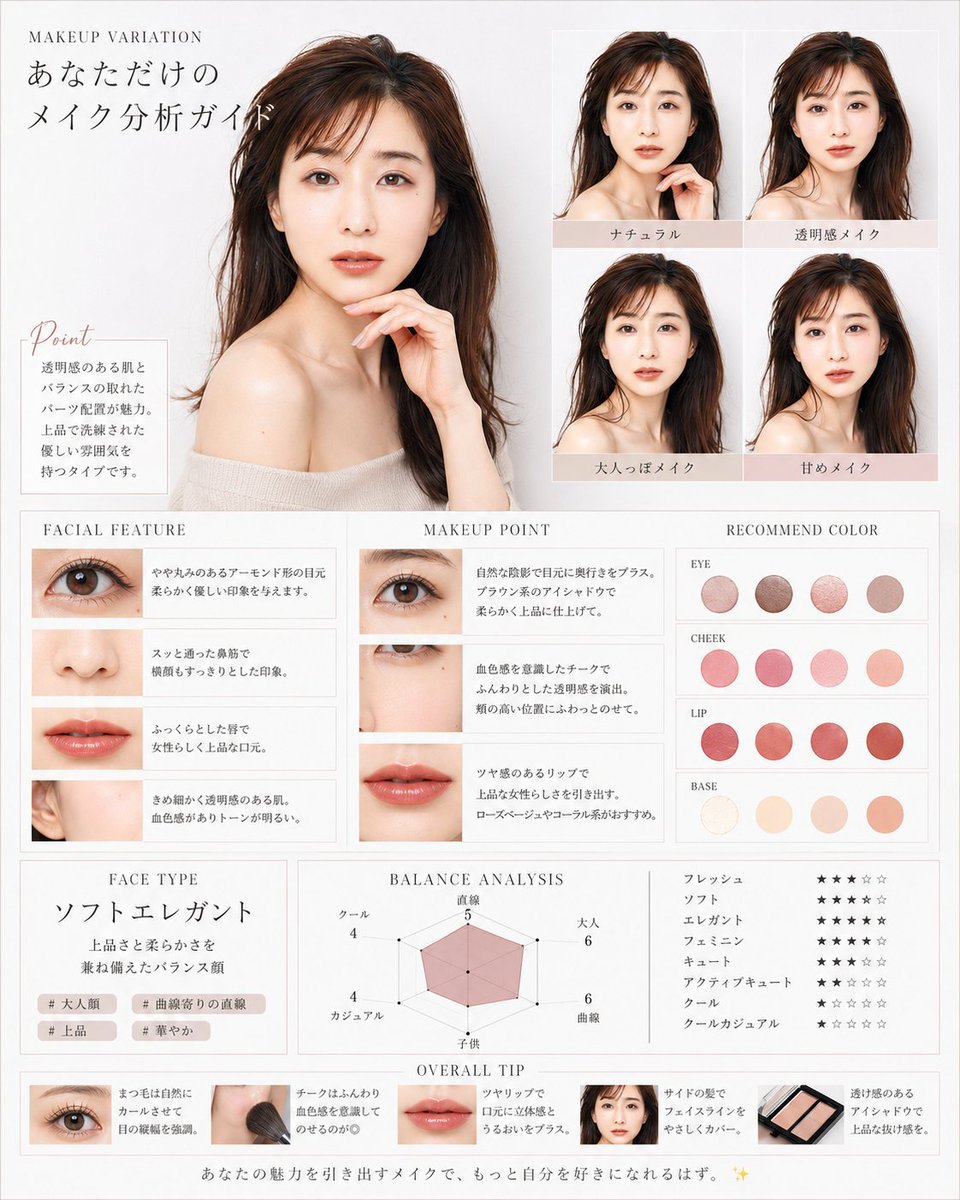
Korean Makeup Analysis Guide
Creates a luxury Korean beauty magazine-style makeup analysis infographic with portraits, feature notes, color recommendations, ratings, and overall tips.
This is a gpt-image-2 prompt case for 时尚美妆. Use the copy-ready prompt below to generate similar visuals, and review YouMind OpenLab awesome-gpt-image-2 attribution plus commercial-use rights before reuse.
Prompt
Copy-ready prompt
Objective: To create an infographic in the style of a luxurious Korean beauty magazine, with the title:{argument name="character name" default="you"} A personalized makeup analysis guide. Using an elegant female model with dewy skin, long dark brown hair, bare shoulders, and a soft beige knit top, creating a semi-transparent effect. The design should convey the quality of a high-end beauty consultation leaflet, using a color scheme of white, ivory, light gray, blush pink, and warm beige. Canvas: A vertical poster, approximately 4:5 in aspect ratio, with a clean white to light gray background with a thin light gray border, using a refined serif font, spacious typography, and natural, soft lighting, presenting a sophisticated editorial photography feel. Main layout: A large half-length portrait of the female model is placed in the upper left corner, occupying approximately 40% of the canvas width and 45% of the height. She faces forward gracefully, one hand near her chin, with glossy brown hair, wearing a cream-colored off-the-shoulder top, radiant skin, and a calm and gentle demeanor. Add small English text "MAKEUP VARIATION" and a large Japanese title "あなただけのメイク分析ガイド" to the upper left. Point Box: Below the large portrait, add a small bordered annotation box titled "Point," with the text describing in Japanese the clear skin, balanced features, highlight placement, and refined elegance. Makeup Variation Grid: Create a 2×2 grid in the upper right corner containing four smaller portrait images, each showing subtle differences in the same woman's makeup. Add a label bar below each image for a light blush, labeled with the following four Japanese tags: "ナチュラル" (Natural), "透明感メイク" (Transparent Makeup), "大人っぽメイク" (Adult Makeup), and "甘めメイク" (Sweet Makeup). Central Analysis Area: Create three bordered columns side-by-side in the center. 1. The "FACIAL FEATURE" column contains 4 horizontal rows of features, each with a close-up photo and Japanese description: eye close-up, nose close-up, lip close-up, and ear/profile skin close-up. 2. The "MAKEUP POINT" column contains 3 horizontal rows of features, each with a close-up photo and suggested text: eye makeup close-up, cheek/under-eye close-up, and lip makeup close-up. 3. The "RECOMMEND COLOR" column displays 16 circular color blocks, arranged in 4 rows of 4 blocks each. The labels are "EYE," "CHEEK," "LIP," and "BASE." A soft rose brown is used for the eyes, a soft pinkish coral for the cheeks, a vibrant rose red/coral for the lips, and an ivory-peach-beige base. The lower analysis area creates three bordered sections. The left-hand "FACE TYPE" section features a large Japanese face image text "ソフトエレガント" (Soft Angel), a Japanese description of balanced, elegant, and soft facial features, and four smaller tags: "#大人顔" (Adult Face), "#曲線寄りの直線" (Straight Line), "#上品" (Superior), and "#華やか" (Beautiful). The central "BALANCE ANALYSIS" section contains a pink, semi-transparent radar chart with six Japanese axes: "直線" (Straight Line), "大人" (Adult), "曲線" (Curved Line), "子供" (Child), "カジュアル" (Chart), and "クール" (Clear), surrounded by small numerical values. The right side section contains 8 lines of Japanese-style ratings, using star icons and labels: “Fresh,” “Soft,” “Elegant,” “Femminn,” “Cut,” “Acquire,” “Cure,” and “Cure Catalogue.” It primarily uses solid black stars and hollow light gray stars. The bottom bar includes an “OVERALL TIP” section with 5 compact suggestion cards arranged horizontally: an eye close-up card, a cheek makeup brush card, a lip close-up card, a small face portrait card, and an eyeshadow palette card. Each card contains a miniature image and brief Japanese makeup advice text. Footer: Add a Japanese closing line at the bottom center: “あなたの魅力を引き出すメイクで、もっと自分を好きになれるはず。 ✨” Visual Style: Minimalist luxury beauty editorial style, Korean-style translucent skin aesthetics, soft shadows, fine dividing lines, blush beige accent strip, elegant serif headings, “Point” in delicate handwritten font, realistic beauty photography, harmonious spacing, and a uncluttered feel. Customizable Details: Models should possess…{argument name="hair color" default="Dark brown"} hair,{argument name="skin finish" default="Clear and moisturized skin"} The overall emphasis should be on the color scheme.{argument name="accent color" default="Light blush beige"} The face tag should be displayed as{argument name="face type label" default="ソフトエレガント"} Constraints: Keep all Japanese labels legible, use the specified number of elements, maintain the same editing grid structure, avoid using logos or watermarks, and do not add extra sections.Prompt variables
Editable argument placeholders found in the prompt, with their default values.
More cases in this category
Prioritized by category, input mode compatibility, quality, and lower risk.
Reuse and source notes
Use this prompt safely after previewing the case.
- 1.Copy the prompt or open it directly in Dovoo with the generation button.
- 2.Adjust variables, aspect ratio, and reference images for your own use case.
- 3.Before publishing or paid usage, verify source rights, attribution requirements, and brand or likeness risks.
Can I use this prompt commercially?
Commercial-use status is unknown. Review the original source, license, brand constraints, and legal requirements before paid usage.
Where does this case come from?
This case is imported from YouMind OpenLab awesome-gpt-image-2; keep attribution visible and check the source URL before reuse.