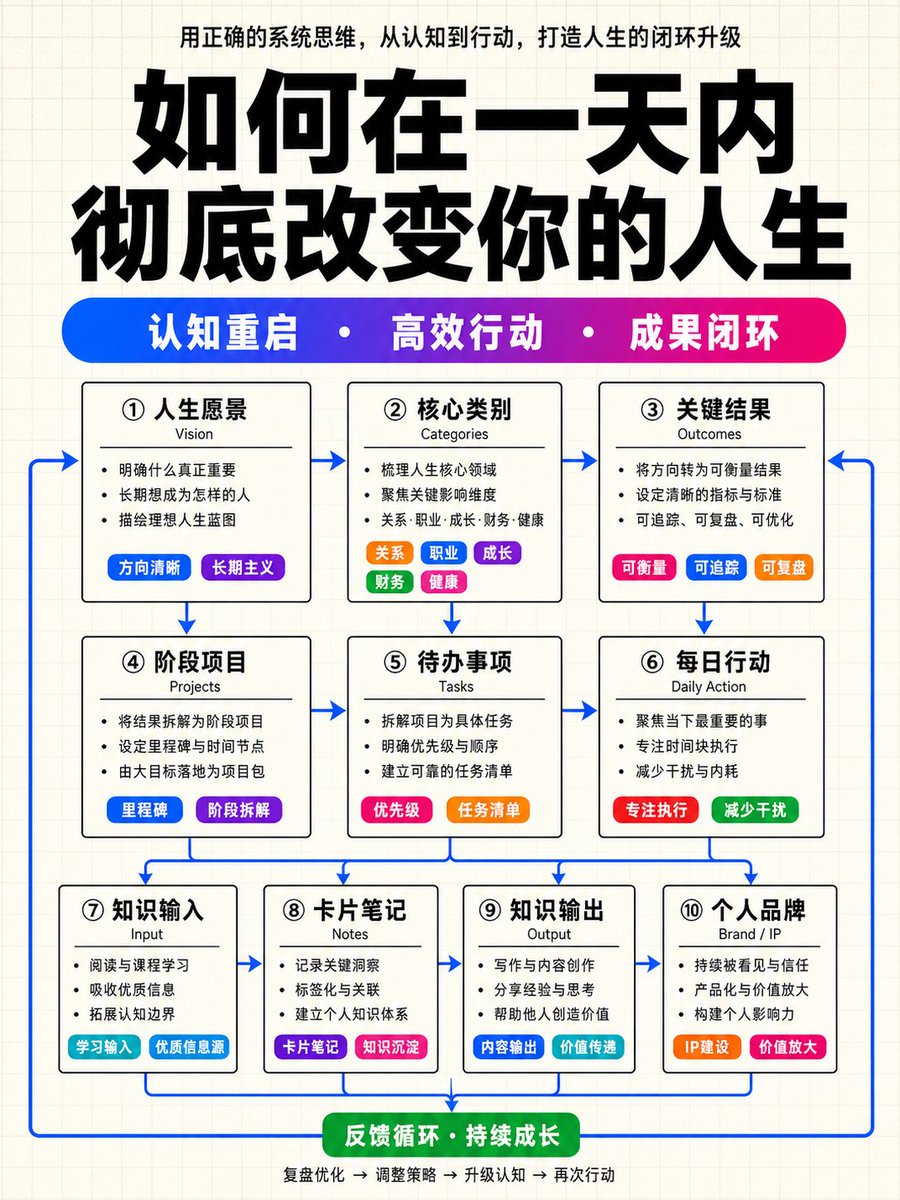
Structured Knowledge Architecture Infographic
A complex system prompt for generating professional, grid-based knowledge maps with high-saturation accent colors and clear hierarchy.
This is a gpt-image-2 prompt case for Graphic & Poster. Use the copy-ready prompt below to generate similar visuals, and review YouMind OpenLab awesome-gpt-image-2 attribution plus commercial-use rights before reuse.
Prompt
Copy-ready prompt
Please generate a high-end Chinese knowledge architecture infographic, using a 9:16 vertical composition. The overall visual language is fixed as follows: light cream-white grid paper background + cover-level extra-large bold title + high-saturation blue-purple-magenta gradient keyword capsule bars + white background with black border structural modules + colorful small capsule labels within modules + blue arrow closed loop connections. This is not a typical flowchart or tech UI panel. Please generate a high-end infographic similar to a high-quality knowledge blogger course cover, a knowledge payment system diagram, or a methodology architecture poster. The overall style must be restrained, simple, and highly ordered, but the local colored labels must be eye-catching enough to make the image richer and more layered than a typical black and white architecture diagram. 1. Fixed visual style: Background: Use a light cream-white grid paper background with very fine light gray grid lines. Gradients, dark backgrounds, heavy shadows, frosted glass effects, skeuomorphism, tech HUDs, or cyberpunk UIs are prohibited. Overall atmosphere: minimalist, restrained, rational, and structurally ordered. Black and white skeleton; colors are only used for keyword bars, small labels, emphasis blocks, and blue arrows. 2. Top Title Area Layout: Top descriptive sentence (centered small text extracted from the content), extra-large bold Chinese main title (the element with the strongest visual impact), and horizontal high-saturation gradient keyword capsule bar (a transition from blue to purple to magenta, containing 3 core keywords separated by white dots). 3. Main Module Structure Rules: 3-layer structure (3 + 3 + 4 modules). A total of 10 modules with white backgrounds, black borders, and small rounded corners. Each module contains a Chinese title, an English subtitle, 2-4 short sentences, and colored capsule tags. 4. Automatic Content Arrangement Rules: Automatically extract and organize content into strategy/cognition (layer 1), action/execution (layer 2), and input/output/brand (layer 3). Use colored tags to label categories, sources, methods, tools, etc. If content is insufficient, maintain the 3+3+4 structure and provide a reasonable summary. 5. Internal Module Color Emphasis: Vibrant colors must come from tags, not background colors. At least 5 modules must contain small capsule labels with high saturation from the blue, purple, magenta, orange, green, and cyan color family. 6. Blue Arrow Loop Rule: Use medium-to-high saturation blue arrows to show a top-to-bottom flow, returning to form a closed loop. 7. Text Hierarchy: Clear hierarchy from main title (boldest/largest) to gradient text, module titles, and then to body text. 8. Final Acceptance Criteria: Ensure the grid background, top description, oversized title, gradient keyword bar, 3+3+4 module structure, colored labels, and blue loop arrows are all presented and meet style requirements. 9. Prohibited Items: Gradient/dark backgrounds, large blocks of color, frosted glass effects, complex illustrations, PPT or mind map styles, and gray arrows are prohibited. 10. User Variables: Top title (enter the main title here) and content (enter the natural language content to be automatically processed here).
Reuse and source notes
Use this prompt safely after previewing the case.
- 1.Copy the prompt or open it directly in Dovoo with the generation button.
- 2.Adjust variables, aspect ratio, and reference images for your own use case.
- 3.Before publishing or paid usage, verify source rights, attribution requirements, and brand or likeness risks.
Can I use this prompt commercially?
Commercial-use status is unknown. Review the original source, license, brand constraints, and legal requirements before paid usage.
Where does this case come from?
This case is imported from YouMind OpenLab awesome-gpt-image-2; keep attribution visible and check the source URL before reuse.