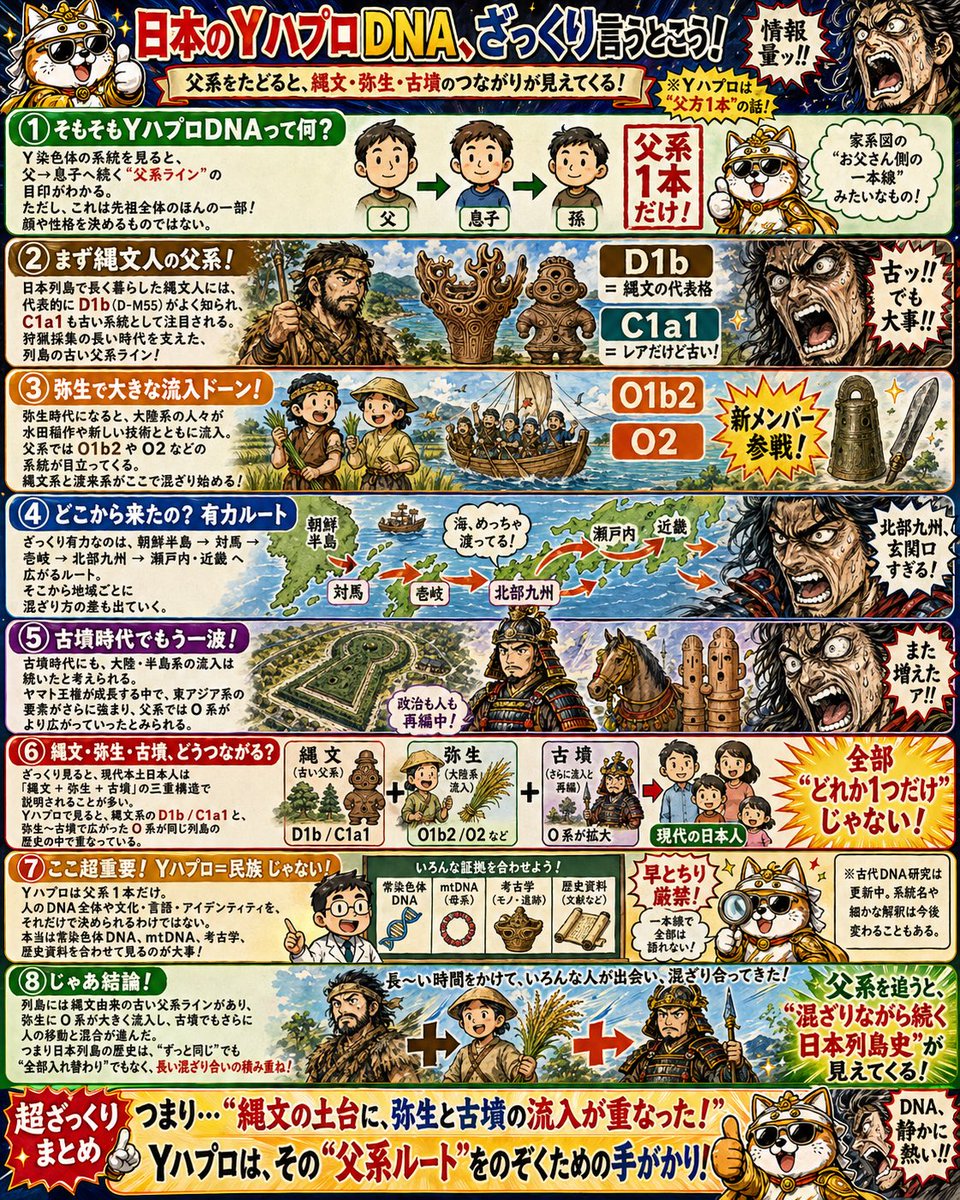
Japanese Y-DNA History Infographic Poster
A dense manga-style educational poster for children that explains Japanese paternal-line DNA history across Jomon, Yayoi, and Kofun periods with maps, diagrams, artifacts, and a recurring dog mascot.
This is a gpt-image-2 prompt case for 平面海报. Use the copy-ready prompt below to generate similar visuals, and review YouMind OpenLab awesome-gpt-image-2 attribution plus commercial-use rights before reuse.
Prompt
Copy-ready prompt
{
  "type": "Japanese History Popular Science Infographic Poster",
  "style": "These compact, comic-style science posters feature highly saturated colors, bold lines, and dramatic comic-style tension. The glossy printing finish and textured paper illustrations are designed specifically for children, offering humor and rich information.",
  "topic": "Y-chromosome DNA and the broader paternal history of the Japanese archipelago",
  "language": "Japanese",
  "aspect_ratio": "Vertical 3:4",
  "headline": {
    "main": "{argument name=\"headline text\" default=\"In simple terms, this is what Y-haploid DNA from Japan looks like!\"}",
    "sub": "By tracing back to the paternal lineage, one can see the connections between the Jomon, Yayoi, and Kofun periods!",
    "badge": "Packed with information!!"
  },
  "mascot": {
    "type": "Cartoon dog historian mascot",
    "count": 4,
    "appearance": "A round, white-brown puppy with a black nose and an expressive mouth, dressed in a magnificent gold historical costume and wearing a crown-like headdress, often points or gives a thumbs-up, playing the role of a comical teacher."
  },
  "layout": {
    "structure": "Eight numbered horizontal sections are arranged vertically, with a top banner and a bottom summary banner.",
    "sections": [
      {
        "title": "① What exactly is Y haplogroup DNA?",
        "position": "Top banner below the section",
        "count": 1,
        "elements": [
          "Explanation of Y-chromosome paternal inheritance",
          "Three male avatar icons are arranged in order, labeled as father, son, and grandson, and connected by a green arrow.",
          "The striking red lettering reads: Only 1 paternity!",
          "The mascot speech bubble is likened to a branch of a family tree."
        ]
      },
      {
        "title": "② First, the paternal lineage of the Jomon people!",
        "position": "Upper area",
        "count": 1,
        "elements": [
          "Illustration of a rugged Jomon hunter wielding a long spear",
          "Three Jomon artifacts/totems are arranged in the center.",
          "Brown label D1b = Representative of Jomon",
          "Blue label C1a1 = Rare but very old!",
          "The dramatic cartoonish shouting emoji on the right, captioned: So old!!! But it's important!!"
        ]
      },
      {
        "title": "③ A large-scale influx during the Yayoi period!",
        "position": "upper middle region",
        "count": 1,
        "elements": [
          "A cheerful Yayoi period figure standing on the shore",
          "Ships carrying immigrants sailed from the mainland.",
          "Orange labels O1b2 and O2",
          "Starburst Text: New Member Joins the Battle!",
          "The rightmost side features an illustration of a small haimachi (potion wheel) and a stone knife."
        ]
      },
      {
        "title": "④ Where did it come from? Main route",
        "position": "Central region",
        "count": 1,
        "elements": [
          "Map of the Korea Strait and western Japan",
          "Visible place name tags: Korean Peninsula, Tsushima, Iki, Northern Kyushu, Setouchi, Kinki",
          "Many red arrows indicate eastward migration routes.",
          "The bubble on the sea surface reads: Crossed so many seas!",
          "The dramatic samurai expression on the right, captioned: Northern Kyushu is practically the gateway!"
        ]
      },
      {
        "title": "⑤ Another wave in the Kofun period!",
        "position": "Middle and lower area",
        "count": 1,
        "elements": [
          "A large aerial view of the front and rear round tomb landscape",
          "In the center is a Kofun period cavalryman clad in armor.",
          "There is a horse and three Haniwa figures on the right.",
          "The rightmost cartoon features a shouting emoji with the caption: \"More added!!\"",
          "The caption next to the samurai reads: \"Politics and population are both undergoing restructuring!\""
        ]
      },
      {
        "title": "⑥ So how do modern people connect with the Kofun period?",
        "position": "lower area",
        "count": 1,
        "elements": [
          "A chart showing Jomon + Yayoi + Kofun = Modern Japanese",
          "Three labeled squares: Jomon (ancient patriarchal lineage), Yayoi (continental lineage), and Kofun (further influx).",
          "Haplogroup tags D1b/C1a1 and O1b2/O2",
          "An arrow pointing to an icon of a modern Japanese family.",
          "The orange exploding text reads: It's not \"only one of them\"!"
        ]
      },
      {
        "title": "⑦ Note! The Y haplogroup is not equivalent to an ethnic group!",
        "position": "Second to last section",
        "count": 1,
        "elements": [
          "A scientist or teacher points to a project board.",
          "Five pieces of evidence are arranged in a row: autosomes, mtDNA, archaeology, and historical data, combining multiple pieces of evidence!",
          "Red warning pop-up box: Taking things out of context is strictly prohibited!",
          "Mascot speech bubble: You can't explain everything with just one clue!",
          "Small print note: This research will be updated over time."
        ]
      },
      {
        "title": "⑧ So the conclusion is!",
        "position": "Bottom content section",
        "count": 1,
        "elements": [
          "Three historical figures stand side by side, separated by a plus sign: a Jomon man, a Yayoi farmer holding rice, and a Kofun samurai holding a spear.",
          "A comprehensive summary of the long-standing multi-ethnic integration.",
          "The bright red emphasis on the continuation of the Japanese archipelago through integration",
          "The mascot in the bottom right corner praises the DNA clues."
        ]
      }
    ],
    "bottom_banner": {
      "count": 1,
      "text": "Super-simplified summary: In other words... \"On top of the Jomon foundation, the influx of Yayoi and Kofun influences was superimposed!\" The Y haplogroup is a clue to glimpsing the \"paternal lineage\"!"
    }
  },
  "figures": {
    "historical_groups": [
      {
        "name": "Jomon",
        "count": 2,
        "visuals": [
          "Rugged spear hunter",
          "Small squares in the ancestral equation"
        ]
      },
      {
        "name": "Yayoi",
        "count": 3,
        "visuals": [
          "2 cheerful immigrants/farmers",
          "Small squares in the ancestral equation"
        ]
      },
      {
        "name": "Kofun",
        "count": 2,
        "visuals": [
          "Cavalry clad in armor",
          "Small squares in the ancestral equation"
        ]
      }
    ],
    "dramatic_faces": {
      "count": 3,
      "description": "The three exaggerated cartoon reaction expressions located on the right edge of sections 2, 4, and 5"
    },
    "artifact_groups": {
      "count": 4,
      "items": [
        "3 Jomon clay figurines or ritual artifacts",
        "1 immigrant ship",
        "One hane and one stone knife from the Yayoi Plate",
        "The three hainaki next to the horse in the Kofun section"
      ]
    }
  },
  "color_palette": {
    "dominant": [
      "Dark red",
      "gold",
      "Dark blue",
      "Forest Green",
      "orange color",
      "Cream",
      "black"
    ],
    "usage": "Each section features a different accent color, along with white text boxes and comic-style pop-up labels."
  },
  "text_density": "Very high quality, containing numerous explanatory paragraphs, labels, arrows, speech bubbles, and impactful text.",
  "image_goal": "Create a child-friendly educational poster for Japanese history that explains paternal Y-DNA haplogroups in a simplified way, combining comic humor, historical illustrations, archaeology, migration maps, and eye-catching typography. Keep the page extremely rich, vibrant, and easy to navigate, including eight numbered sections and a recurring commentary featuring a dog mascot."
}
Prompt variables
Editable argument placeholders found in the prompt, with their default values.
More cases in this category
Prioritized by category, input mode compatibility, quality, and lower risk.



Reuse and source notes
Use this prompt safely after previewing the case.
- 1.Copy the prompt or open it directly in Dovoo with the generation button.
- 2.Adjust variables, aspect ratio, and reference images for your own use case.
- 3.Before publishing or paid usage, verify source rights, attribution requirements, and brand or likeness risks.
Can I use this prompt commercially?
Commercial-use status is unknown. Review the original source, license, brand constraints, and legal requirements before paid usage.
Where does this case come from?
This case is imported from YouMind OpenLab awesome-gpt-image-2; keep attribution visible and check the source URL before reuse.