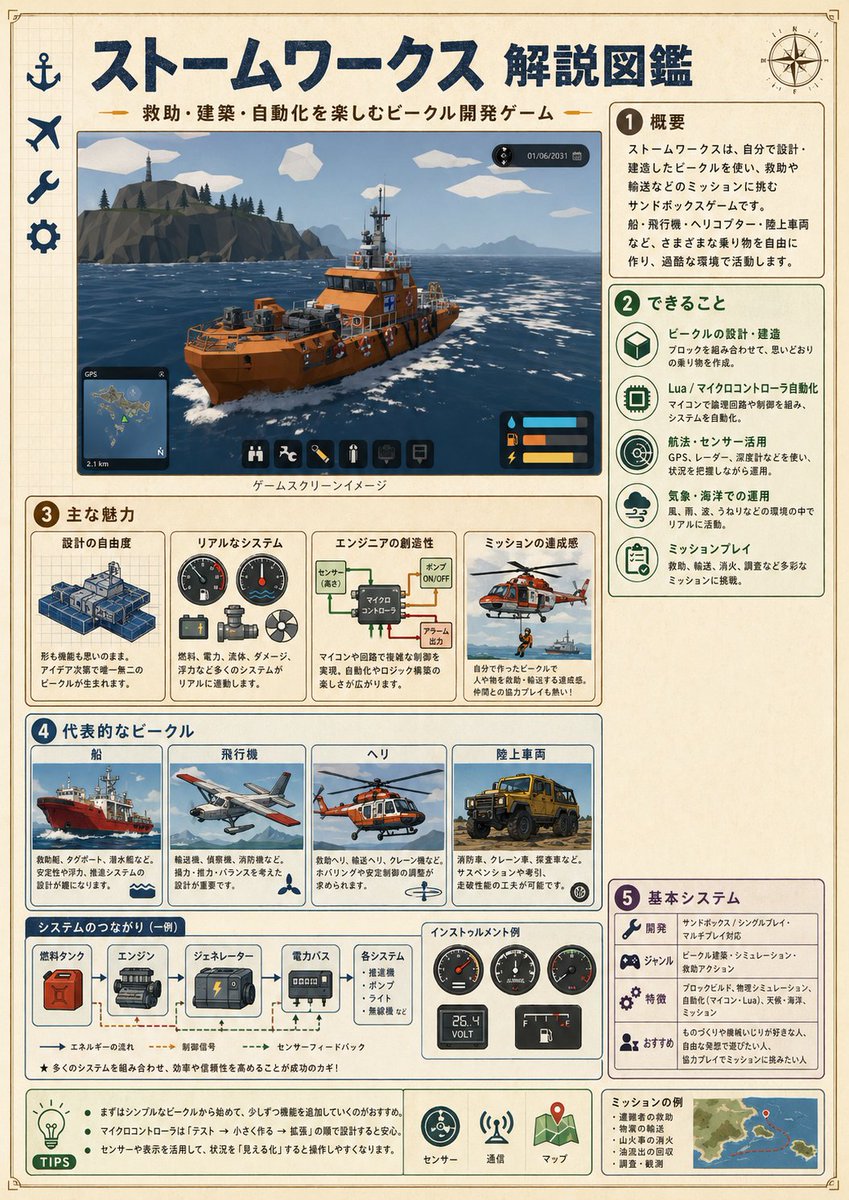
Japanese Stormworks Guide Infographic
A detailed Japanese infographic poster explaining a vehicle-building rescue game, suitable for creating handbook-style game overview visuals or social media explainer images.
This is a gpt-image-2 prompt case for 平面海报. Use the copy-ready prompt below to generate similar visuals, and review YouMind OpenLab awesome-gpt-image-2 attribution plus commercial-use rights before reuse.
Prompt
Copy-ready prompt
{
  "type": "Japanese game instruction infographic poster",
  "topic": "{argument name=\"game title\" default=\"Stormworks\"}",
  "style": "The infographics, featuring a simple, illustration style on a beige vintage paper background, a light-colored grid background, navy blue headings, and rounded-corner panels, blend the style of a technical manual with a fun game guide. The print is clear and highly readable, with a subtle aged texture.",
  "language": "Chinese",
  "format": "Vertical poster",
  "layout": {
    "header": {
      "title": "{argument name=\"main title\" default=\"Stormworks Detailed Guide\"}",
      "subtitle": "{argument name=\"subtitle text\" default=\"Enjoy a vehicle development game that combines rescue, construction, and automation.\"}",
      "left_icons_count": 4,
      "left_icons": [
        "anchor",
        "airplane",
        "wrench",
        "gear"
      ],
      "top_right_icon": "compass rose"
    },
    "sections": [
      {
        "title": "1. Overview",
        "position": "upper right",
        "count": 1,
        "labels": [
          "overview"
        ],
        "content": "The brief Chinese paragraph introduces this as an engineering and rescue sandbox game where players can design and build vehicles, transport cargo, and complete missions in harsh natural environments; it mentions ships, airplanes, helicopters, and land vehicles."
      },
      {
        "title": "2 Core Gameplay",
        "position": "right middle",
        "count": 5,
        "labels": [
          "Vehicle design and construction",
          "Lua / Microcontroller Automation",
          "Navigation and Sensor Applications",
          "Operations in meteorological and marine environments",
          "Mission Challenge"
        ],
        "icon_style": "Green circular line icon",
        "content": "Five vertically arranged function cards, each containing an icon, a bold title, and two to three lines of Chinese explanatory text."
      },
      {
        "title": "3. Main attractions",
        "position": "middle wide panel",
        "count": 4,
        "labels": [
          "Design freedom",
          "Real System",
          "Engineers' Creativity",
          "Sense of accomplishment"
        ],
        "content": "Four cards side by side, with small illustrations and explanatory text."
      },
      {
        "title": "4 Representative Vehicles",
        "position": "lower middle large panel",
        "count": 4,
        "labels": [
          "Boat",
          "airplane",
          "helicopter",
          "land vehicles"
        ],
        "content": "The top row contains four bordered vehicle example cards, each with an image and a brief Chinese description; the bottom strip contains a system flowchart and a dashboard example."
      },
      {
        "title": "5. Basic System",
        "position": "lower right",
        "count": 4,
        "labels": [
          "Development",
          "type",
          "Features",
          "recommend"
        ],
        "content": "A compact four-line list with small icons and brief Chinese descriptions."
      }
    ],
    "footer": {
      "left_box_title": "TIPS",
      "left_box_bullets_count": 2,
      "left_box_bullets": [
        "It is recommended to start with simple vehicles and gradually add features.",
        "For microcontrollers, it's recommended to follow the sequence of 'testing → small-scale production → scaling' for greater stability. Visualizing the status using sensors and displays makes operation easier."
      ],
      "center_icons_count": 3,
      "center_icons": [
        "sensor",
        "communication tower",
        "map pin on folded map"
      ],
      "right_box_title": "Task Example",
      "right_box_items_count": 5,
      "right_box_items": [
        "Rescue the distressed",
        "Material transportation",
        "Forest fire fighting",
        "Oil Sewage Recycling",
        "Survey and observation"
      ],
      "right_box_visual": "Small island map"
    }
  },
  "main_image": {
    "position": "upper left large panel",
    "description": "A bright orange rescue vessel sails on the deep blue sea, kicking up white spray. The shot, taken from a three-quarter angle, shows black railings and deck equipment against a backdrop of rocky islands covered in pine trees and a lighthouse. Stylized white polygonal clouds dot the light blue sky.",
    "caption": "Game screen illustration",
    "overlay_ui_count": 4,
    "overlay_ui": [
      "Small dark date/time HUD in the upper right corner",
      "GPS mini-map in the bottom left corner",
      "Six square toolbar icons centered at the bottom",
      "A compact status panel with three colored progress bars in the bottom right corner."
    ]
  },
  "sub_panels": {
    "section_3_images_count": 4,
    "section_3_images": [
      "Modular ship design blocks similar to blueprints",
      "Three circular instruments with mechanical parts",
      "Logic diagram with label boxes and arrows",
      "An orange rescue helicopter above the sea and a small illustration scene."
    ],
    "section_4_vehicle_images_count": 4,
    "section_4_vehicle_images": [
      "A huge red ship on the sea",
      "A single-engine propeller plane in flight",
      "Orange-white helicopter",
      "Yellow off-road multi-purpose truck"
    ],
    "systems_flow": {
      "title": "System connection (example)",
      "count": 5,
      "labels": [
        "fuel tank",
        "engine",
        "dynamo",
        "Power bus",
        "Each system"
      ],
      "arrows": [
        "Energy Flow",
        "control signals",
        "Sensor feedback"
      ]
    },
    "instrument_example": {
      "title": "Dashboard Example",
      "gauges_count": 5,
      "gauges": [
        "Tachometer-type instrument",
        "Speedometer instrument",
        "Pressure or temperature gauge",
        "Digital voltage display: 25.4 VOLT",
        "Fuel gauge"
      ]
    }
  },
  "visual_requirements": {
    "aspect_ratio": "3:4",
    "rendering": "A combination of flat infographic graphics and semi-realistic game screenshots/hand-drawn illustrations",
    "color_palette": [
      "Navy Blue",
      "Forest Green",
      "orange color",
      "Beige",
      "light blue",
      "grey"
    ],
    "linework": "Clear printing outline",
    "typography": "The title uses bold Chinese font, and the body text uses a clean sans-serif Chinese font.",
    "overall_feel": "Educational field guides, game manuals, and posters are exquisite and user-friendly."
  }
}
Prompt variables
Editable argument placeholders found in the prompt, with their default values.
More cases in this category
Prioritized by category, input mode compatibility, quality, and lower risk.




Reuse and source notes
Use this prompt safely after previewing the case.
- 1.Copy the prompt or open it directly in Dovoo with the generation button.
- 2.Adjust variables, aspect ratio, and reference images for your own use case.
- 3.Before publishing or paid usage, verify source rights, attribution requirements, and brand or likeness risks.
Can I use this prompt commercially?
Commercial-use status is unknown. Review the original source, license, brand constraints, and legal requirements before paid usage.
Where does this case come from?
This case is imported from YouMind OpenLab awesome-gpt-image-2; keep attribution visible and check the source URL before reuse.