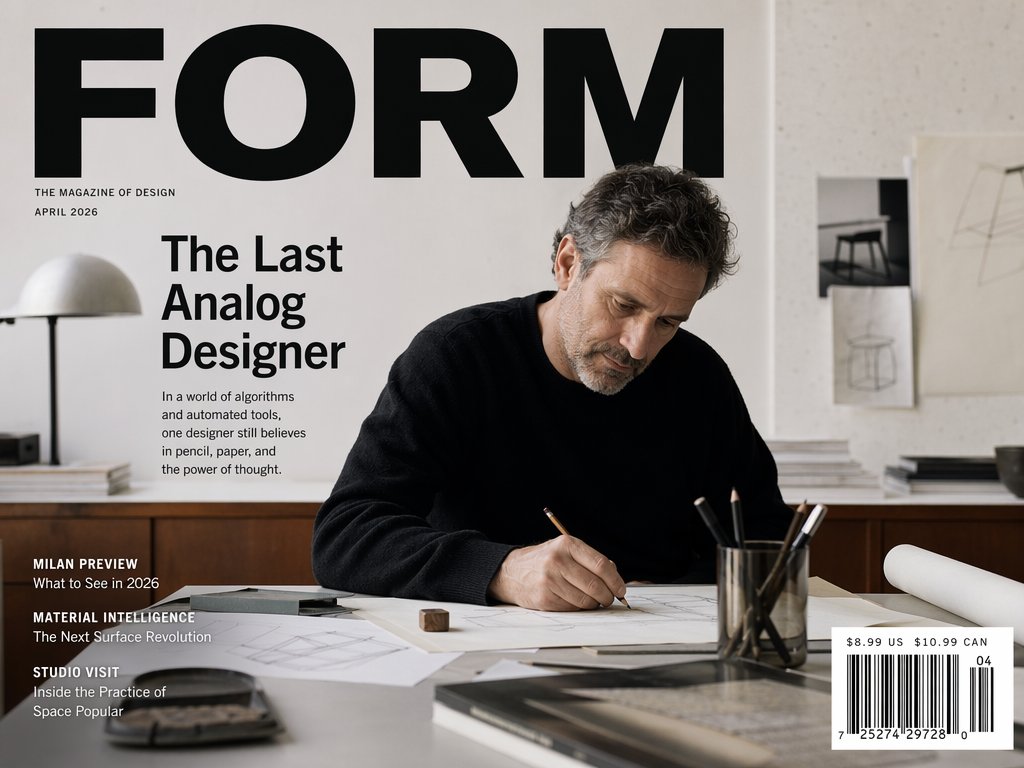
Fictional Design Magazine Cover
This prompt generates a realistic editorial magazine cover featuring an anonymous designer in a minimalist studio, ideal for concept art, mock covers, and design-themed visual storytelling.
This is a gpt-image-2 prompt case for Graphic & Poster. Use the copy-ready prompt below to generate similar visuals, and review YouMind OpenLab awesome-gpt-image-2 attribution plus commercial-use rights before reuse.
Prompt
Copy-ready prompt
A hyper-realistic modern magazine cover, used for a magazine called{argument name="magazine title" default="FORM"} This fictional design magazine features a style reminiscent of high-end editorial portraits taken in a minimalist architect's studio. The cover employs a clean, restrained European design aesthetic, with ample white space, sharp typography, and warm indoor natural lighting. At the top, a large, bold black sans-serif masthead spans almost the entire width. To the lower left of the masthead, a line of small-capitalized text reads "THE MAGAZINE OF DESIGN" and "APRIL 2026." The main cover title on the left is {argument name="cover headline" default="The Last Analog Designer"} The text uses a large, multi-line, stacked black sans-serif font. Below, a smaller teaser text is added: "In a world of algorithms and automation tools, there is still a designer who believes in the power of pencil, paper, and thought." In the lower left corner, above a darker desktop area, three lines of small white sans-serif secondary cover titles are added: "MILAN PREVIEW" with "What to See in 2026," "MATERIAL INTELLIGENCE" with "The Next Surface Revolution," and "STUDIO VISIT" with "Inside the Practice of Space Popular." In the lower right corner, a realistic white barcode frame is added, with small price text "$8.99 US $10.99 CAN" and issue number "04" above it. The image shows a middle-aged male designer sitting at a workbench, wearing a dark blue or black knit sweater, with graying curly hair, sketching on white paper with a pencil. His face is obscured by a square blur, creating a sense of anonymous portraiture. There are eight clearly visible items on the table: scattered sketches of geometric chairs, a pen holder containing several pencils, a rolled-up white blueprint on the right, a closed dark notebook on the left, a small brown eraser near the center, a blurry black object to the left front, a large flat book or material sample to the right front, and the drawings he is currently working on. Behind him is a warm wooden sideboard neatly stacked with books, a white domed lamp on the far left, and four design references pinned to the white wall: a small photograph of a dark chair, a light-colored sketch below, and two larger minimalist line drawings to the right. The use of soft neutral tones, off-white walls, walnut wood, and black clothing creates an atmosphere of calm contemplation. The composition should convey the quality of a believable high-end magazine cover, employing a direct view and careful art direction, possessing the realism of editorial photography, and containing no visible publisher logos except for a fictional masthead.Prompt variables
Editable argument placeholders found in the prompt, with their default values.
Reuse and source notes
Use this prompt safely after previewing the case.
- 1.Copy the prompt or open it directly in Dovoo with the generation button.
- 2.Adjust variables, aspect ratio, and reference images for your own use case.
- 3.Before publishing or paid usage, verify source rights, attribution requirements, and brand or likeness risks.
Can I use this prompt commercially?
Commercial-use status is unknown. Review the original source, license, brand constraints, and legal requirements before paid usage.
Where does this case come from?
This case is imported from YouMind OpenLab awesome-gpt-image-2; keep attribution visible and check the source URL before reuse.