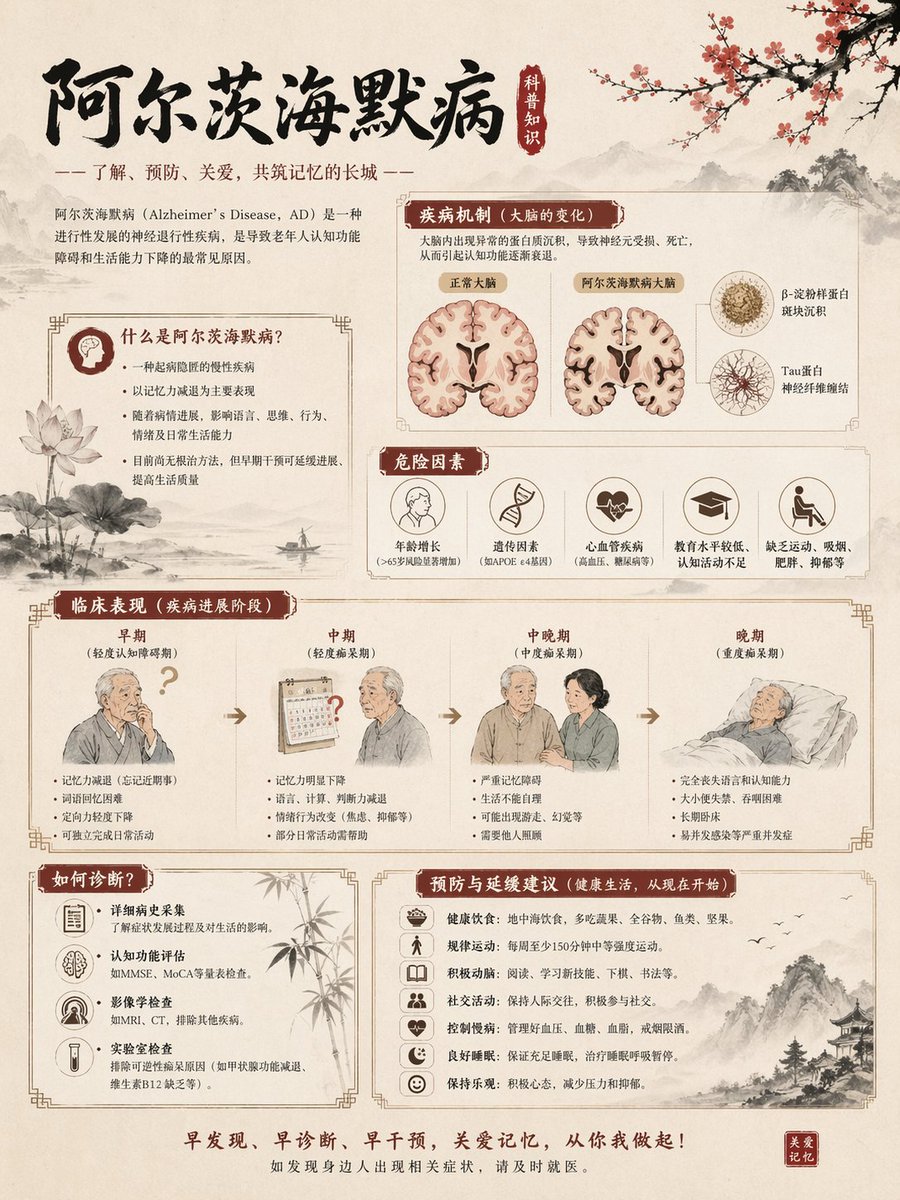
Chinese Alzheimer’s Awareness Infographic
A traditional Chinese-style medical infographic poster explaining Alzheimer’s disease, designed for public health education, awareness campaigns, and social media comparison posts.
This is a gpt-image-2 prompt case for Graphic & Poster. Use the copy-ready prompt below to generate similar visuals, and review YouMind OpenLab awesome-gpt-image-2 attribution plus commercial-use rights before reuse.
Prompt
Copy-ready prompt
{
  "type": "Traditional Chinese medical science popularization posters",
  "topic": "Alzheimer's disease",
  "style": {
    "overall": "Elegant Chinese ink painting style health education poster with a vintage parchment paper design",
    "palette": "A warm beige background, dark brown text, a soft red title banner, and light gray ink wash landscape accents.",
    "rendering": "Simple infographics combined with hand-drawn watercolor illustrations and lightweight line icons",
    "mood": "Serious, professional, and full of humanistic care"
  },
  "canvas": {
    "orientation": "Vertical",
    "composition": "A single-page poster, including a header, multiple information sections, and a footer slogan."
  },
  "text": {
    "main_title": "Alzheimer's disease",
    "subtitle": "— Understanding, Prevention, and Care: Building a Great Wall of Memory —",
    "body_language": "Simplified Chinese",
    "footer_slogan": "Early detection, early diagnosis, and early intervention are key to protecting memory; let's start with ourselves!",
    "footer_note": "If you notice anyone around you exhibiting these symptoms, please seek medical attention promptly."
  },
  "decorative_elements": {
    "count": 6,
    "items": [
      "plum blossom branch in the upper right corner",
      "The hazy landscape in the background",
      "Lotus flowers and leaves in the lower left corner",
      "Small boat in the water at the lower left center",
      "Bamboo illustration next to the diagnostic section",
      "The distant mountains and pavilion with flying birds in the lower right corner"
    ]
  },
  "layout": {
    "sections": [
      {
        "title": "What is Alzheimer's disease?",
        "position": "Top left",
        "count": 4,
        "labels": [
          "A chronic disease with insidious onset",
          "The main symptom is memory loss.",
          "As the disease progresses, it affects language, thinking, behavior, emotions, and daily living abilities.",
          "There is currently no cure, but early intervention can slow progression and improve quality of life."
        ]
      },
      {
        "title": "Disease mechanisms (changes in the brain)",
        "position": "Top right",
        "count": 4,
        "labels": [
          "Abnormal protein deposits in the brain can damage and kill neurons, leading to a gradual decline in cognitive function.",
          "normal brain",
          "brain of Alzheimer's patients",
          "β-amyloid plaque deposition and Tau protein neurofibrillary tangles"
        ]
      },
      {
        "title": "Risk factors",
        "position": "Right Center",
        "count": 5,
        "labels": [
          "The risk increases significantly with age (>65 years).",
          "Genetic factors (such as the APOE ε4 gene)",
          "Cardiovascular diseases (hypertension, diabetes, etc.)",
          "Low level of education and insufficient cognitive activity",
          "Lack of exercise, smoking, obesity, depression, etc."
        ]
      },
      {
        "title": "Clinical manifestations (disease progression stage)",
        "position": "lower middle center",
        "count": 4,
        "labels": [
          "Early stage (mild cognitive impairment)",
          "Mid-stage (mild dementia)",
          "Mid-to-late stage (moderate dementia)",
          "Late stage (severe dementia)"
        ]
      },
      {
        "title": "How to diagnose it?",
        "position": "Bottom left",
        "count": 4,
        "labels": [
          "Detailed medical history taking",
          "Cognitive function assessment",
          "Imaging examination",
          "Laboratory tests"
        ]
      },
      {
        "title": "Prevention and Delay Recommendations (Healthy Living Starts Now)",
        "position": "Bottom right",
        "count": 7,
        "labels": [
          "Healthy diet: Mediterranean diet, eat more fruits and vegetables, whole grains, fish and nuts.",
          "Regular exercise: at least 150 minutes of moderate-intensity exercise per week.",
          "Engage your mind actively: reading, learning new skills, playing chess, calligraphy, etc.",
          "Social activities: Maintain interpersonal relationships and actively participate in social activities.",
          "Controlling chronic diseases: manage blood pressure, blood sugar, and blood lipids; quit smoking and limit alcohol consumption.",
          "Good sleep: Ensure sufficient sleep and treat sleep apnea.",
          "Maintain an optimistic attitude: a positive mindset reduces stress and depression."
        ]
      }
    ],
    "centerpiece": "A large, multi-section educational layout, complete with red section titles and detailed decorative borders."
  },
  "illustrations": {
    "count": 14,
    "items": [
      "Two cross-sectional images comparing a healthy brain and a brain with Alzheimer's disease.",
      "Two circular pathological illustrations showing amyloid plaques and tau protein tangles.",
      "5 circular risk factor icons",
      "Four illustrations showing the progression of patients from mild cognitive impairment to the late stage of bedriddenness.",
      "A clipboard icon for the diagnostics section and accompanying medical-themed icons."
    ]
  },
  "typography": {
    "headline": "Large and expressive black calligraphy title",
    "section_headers": "White Chinese characters on a banner with dark red brushstrokes",
    "body": "Neat, printed Chinese font with appropriate character spacing."
  },
  "quality": "High-resolution, balanced typography suitable for sharing on social media, public education, or clinic promotion."
}
Reuse and source notes
Use this prompt safely after previewing the case.
- 1.Copy the prompt or open it directly in Dovoo with the generation button.
- 2.Adjust variables, aspect ratio, and reference images for your own use case.
- 3.Before publishing or paid usage, verify source rights, attribution requirements, and brand or likeness risks.
Can I use this prompt commercially?
Commercial-use status is unknown. Review the original source, license, brand constraints, and legal requirements before paid usage.
Where does this case come from?
This case is imported from YouMind OpenLab awesome-gpt-image-2; keep attribution visible and check the source URL before reuse.