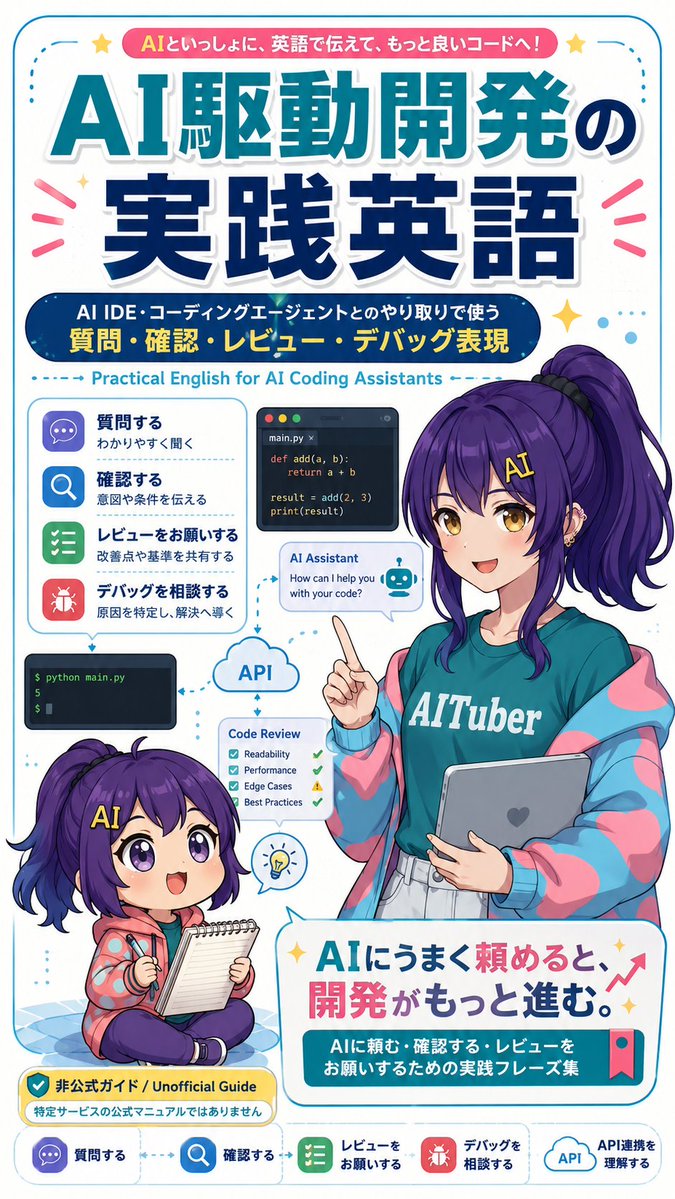
AI Coding English Learning Poster
Generates a dense Japanese anime-style educational poster for practical English phrases used with AI coding assistants and AI IDE workflows.
This is a gpt-image-2 prompt case for Graphic & Poster. Use the copy-ready prompt below to generate similar visuals, and review YouMind OpenLab awesome-gpt-image-2 attribution plus commercial-use rights before reuse.
Prompt
Copy-ready prompt
{
  "type": "Vertical Japanese-style educational poster / AI programming English learning magazine cover infographic",
  "format": "A vertical poster designed for mobile viewing, with a 2:3 aspect ratio, rounded corners, a light blue border, a simple white background, a compact yet lively layout, and a blend of glossy anime and flat infographic styles.",
  "main_text": {
    "top_ribbon": "{argument name=\"top ribbon text\" default=\"Collaborate with AI, communicate in English, and write better code!\"}",
    "main_headline": "{argument name=\"main headline\" default=\"Practical English for AI-Driven Development\"}",
    "subheadline": "{argument name=\"subheadline\" default=\"Expressions for asking questions, confirming, reviewing, and debugging when interacting with AI IDEs and agents.\"}",
    "english_subtitle": "Practical English for AI Coding Assistants",
    "bottom_slogan": "{argument name=\"bottom slogan\" default=\"Make good use of AI to further improve development efficiency.\"}",
    "bottom_caption": "A collection of useful phrases for asking AI questions, confirming intent, and requesting code review."
  },
  "characters": {
    "count": 2,
    "adult_character": {
      "position": "On the right, occupying the lower middle part",
      "description": "A young female instructor with an anime-style look, wearing a high ponytail and dark purple hair, a light blue T-shirt with the words 'AITuber' printed on it, an oversized pink and light blue patchwork jacket, a light-colored skirt, and holding a tablet with a heart symbol, raising her index finger in a teaching gesture; her face is softly obscured by a blurred rectangle.",
      "hair_color": "{argument name=\"hair color\" default=\"Dark purple\"}"
    },
    "chibi_character": {
      "position": "bottom left corner",
      "description": "A chibi version of the same purple-haired character, sitting cross-legged on a blue plaid cushion, with large purple eyes, wearing a yellow 'AI' hair clip, holding a pen and notebook, and wearing a coral hoodie with blue polka dots, paired with dark trousers."
    }
  },
  "layout": {
    "sections": [
      {
        "title": "Left-side phrase category list",
        "position": "Left and Middle",
        "count": 4,
        "items": [
          {
            "label": "Question",
            "subtext": "Clearly state the question",
            "icon": "Purple chat bubbles"
          },
          {
            "label": "confirm",
            "subtext": "Communicating Intent and Conditions",
            "icon": "blue magnifying glass"
          },
          {
            "label": "Request for review",
            "subtext": "Share improvement points and standards",
            "icon": "Green List"
          },
          {
            "label": "Consultation and debugging",
            "subtext": "Identify the cause and solve the problem",
            "icon": "Small red worms"
          }
        ]
      },
      {
        "title": "Programming Workflow Mini Panel",
        "position": "From center left to center",
        "count": 5,
        "items": [
          {
            "description": "A dark code editor card displays the filename main.py and a simple Python function add(a, b), which returns a + b, result = add(2, 3), and print(result)."
          },
          {
            "description": "An AI Assistant chat bubble displays 'How can I help you with your code?' accompanied by a small robot icon."
          },
          {
            "description": "The dark terminal panel displays '$ python main.py' and the output '5'."
          },
          {
            "description": "The clouds marked 'API' are connected by dashed arrows."
          },
          {
            "description": "The code review checklist includes four checks: readability, performance, boundary cases, and best practices."
          }
        ]
      },
      {
        "title": "Guide Tags",
        "position": "Above the bottom left footer",
        "count": 1,
        "items": [
          {
            "label": "Unofficial Guide",
            "subtext": "Official manual for non-specific services",
            "style": "Yellow, rounded-corner warning badge with a shield checkmark icon."
          }
        ]
      },
      {
        "title": "Footer navigation",
        "position": "bottom",
        "count": 5,
        "items": [
          {
            "label": "Question",
            "icon": "Purple chat bubbles"
          },
          {
            "label": "confirm",
            "icon": "blue magnifying glass"
          },
          {
            "label": "Request for review",
            "icon": "Green List"
          },
          {
            "label": "Consultation and debugging",
            "icon": "Small red worms"
          },
          {
            "label": "Understanding API Integration",
            "icon": "API Cloud"
          }
        ]
      }
    ],
    "decorations": "The connecting panel features a cyan dashed arrow, pink radiating lines around the title, yellow twinkling stars, small blue dots, a red rising arrow near the bottom slogan, and a bookmark ribbon on the bottom card."
  },
  "typography": "Large, bold Japanese title with a cyan top border and navy blue bottom border, white outline and drop shadow; rounded sans-serif font description; cyan, navy blue, pink, and yellow color scheme.",
  "rendering": "A clear vector-style poster design, high resolution, exquisite Japanese learning material cover, lively and educational, non-realistic style."
}
Prompt variables
Editable argument placeholders found in the prompt, with their default values.
Variable
top ribbon text
Default
Collaborate with AI, communicate in English, and write better code!
Variable
main headline
Default
Practical English for AI-Driven Development
Variable
subheadline
Default
Expressions for asking questions, confirming, reviewing, and debugging when interacting with AI IDEs and agents.
Variable
bottom slogan
Default
Make good use of AI to further improve development efficiency.
Variable
hair color
Default
Dark purple
Reuse and source notes
Use this prompt safely after previewing the case.
- 1.Copy the prompt or open it directly in Dovoo with the generation button.
- 2.Adjust variables, aspect ratio, and reference images for your own use case.
- 3.Before publishing or paid usage, verify source rights, attribution requirements, and brand or likeness risks.
Can I use this prompt commercially?
Commercial-use status is unknown. Review the original source, license, brand constraints, and legal requirements before paid usage.
Where does this case come from?
This case is imported from YouMind OpenLab awesome-gpt-image-2; keep attribution visible and check the source URL before reuse.