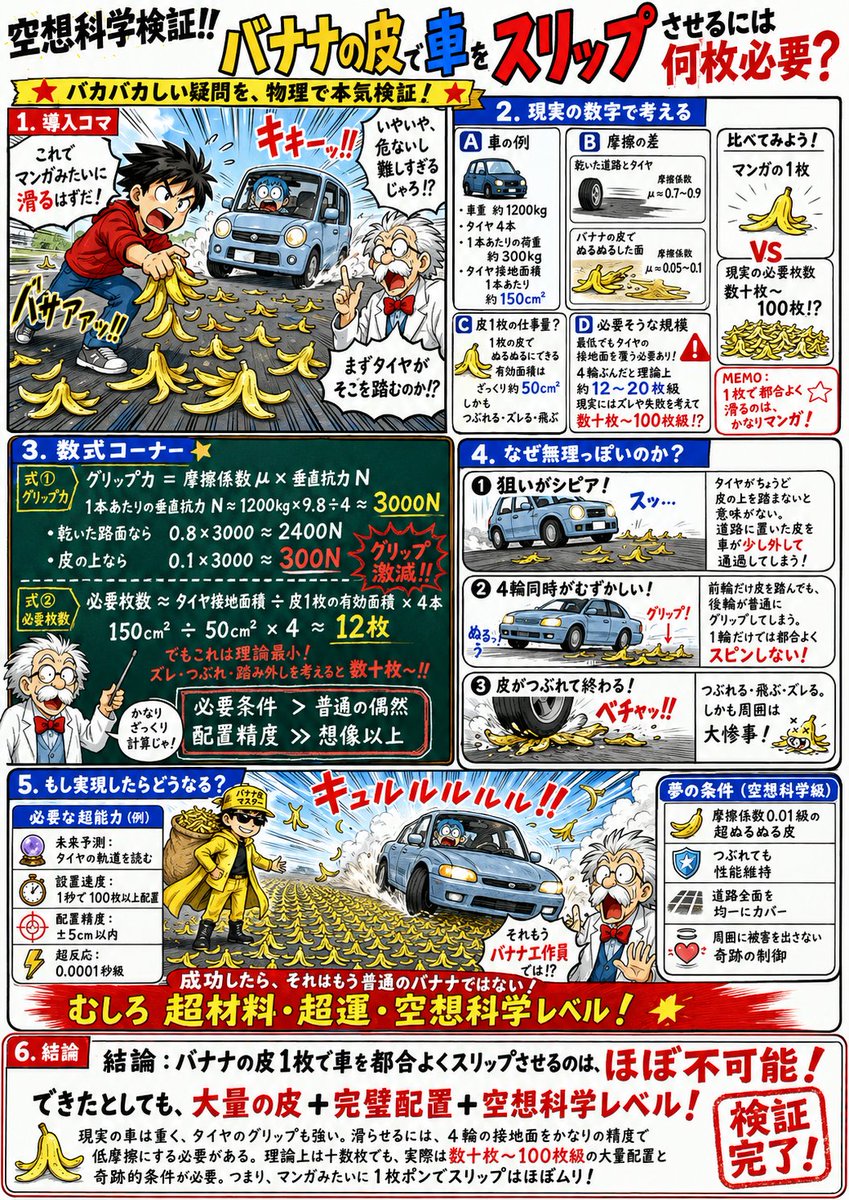
Fictional Science Infographic Generator
A highly detailed, structured prompt for creating retro-style comic infographics that verify absurd fictional scenarios with serious scientific calculations and diagrams.
This is a gpt-image-2 prompt case for 插画艺术. Use the copy-ready prompt below to generate similar visuals, and review YouMind OpenLab awesome-gpt-image-2 attribution plus commercial-use rights before reuse.
Prompt
Copy-ready prompt
Create a fun science explanation illustration. The topic must be verified as "".{argument name="validation theme" default="How many banana peels would it take to make a car skid?"} A vertical A4-sized comic-style infographic rigorously verifies an absurd problem using science and calculation. White background, thick black lines, and accent colors of red, blue, and yellow. The design style evokes retro educational comics, science reference books, or science columns. It uses a professor character, surprised passersby, speech bubbles, hand-drawn arrows, red pen annotations, and blackboard-style formula boxes. The overall atmosphere should be "going all out to verify a stupid problem with physics," fun, energetic, and not overly serious. Structure: 1. The opening depicts the thematic scenario in an exaggerated and absurd way, making it immediately understandable. The characters are going all out, but look rather reckless. The professor interjects with comments. 2. Using real data, it presents 3 to 4 important numerical boxes related to the topic, such as speed, time, distance, weight, force, temperature, or energy. Includes comparison charts or timelines to clearly show the gap between "human senses" and the "scale of the phenomenon." 3. The formula corner uses blackboard-style boxes to extensively illustrate necessary conditions or comparative formulas. Examples: "Required ability > Human limits," "Reaction time < "Time of occurrence of the phenomenon", "Required force/speed/endurance ≫ Ordinary human". The formula does not need to be absolutely precise, just keep it intuitive and easy to understand. 4. Is it possible? Explain the problem points with three short panels. Examples: ① Too fast/Too heavy/Too hot ② Precision requirements are too stringent ③ Even if successful, the body cannot withstand it/The surrounding environment will suffer. Include humorous illustrations of failure, onomatopoeia, and speech bubbles. 5. What would happen if it were achieved? Make this part the focus. Describe the superhuman or speculative scientific abilities required for actual success. For example: super reflexes, future prediction, abnormal grip strength, super-fast vision, physical qualities that ignore air resistance, or bones that can withstand impact. If necessary, use scientifically impossible numbers, such as "reaction speed 0.0001 seconds", "grip strength 3000kg", "dynamic vision dozens of times better than that of a fighter pilot". In addition, describe the scene of the moment of achievement. Example: The arm is blown away, sinks into the ground, a shock wave is generated around, but the person involved remains calm. In a fun way, bring out the feeling that "if it succeeds, they will no longer be human". 6. The conclusion should be written in a large, highlighted red box. It should state, "Conclusion: XX is virtually impossible for ordinary humans!" or "Even if achieved, it would require superhuman, cyborg, or speculative scientific abilities!" The summary should explain that while impossible for real humans, it can be achieved through speculative scientific capabilities. Design guidelines: Comic panels + scientific illustrations + professor commentary. Frequent use of bold headings, red circles, emphasis lines, hand-drawn notes, and speech bubbles. Formulas and values should be large enough and easy to read, allowing even children to intuitively understand the information. The final result should resemble a page of fun, absurd, yet surprisingly convincing science literature.Prompt variables
Editable argument placeholders found in the prompt, with their default values.
More cases in this category
Prioritized by category, input mode compatibility, quality, and lower risk.

Reuse and source notes
Use this prompt safely after previewing the case.
- 1.Copy the prompt or open it directly in Dovoo with the generation button.
- 2.Adjust variables, aspect ratio, and reference images for your own use case.
- 3.Before publishing or paid usage, verify source rights, attribution requirements, and brand or likeness risks.
Can I use this prompt commercially?
Commercial-use status is unknown. Review the original source, license, brand constraints, and legal requirements before paid usage.
Where does this case come from?
This case is imported from YouMind OpenLab awesome-gpt-image-2; keep attribution visible and check the source URL before reuse.