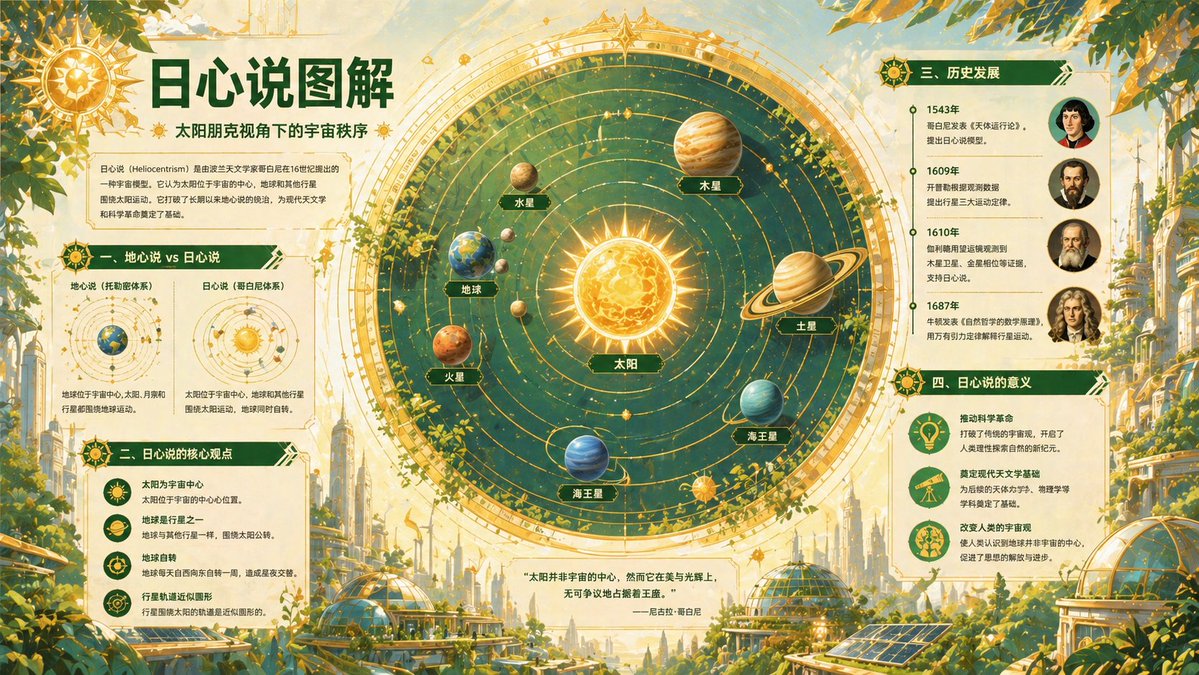
Heliocentric Theory Infographic Poster
A richly detailed Chinese educational infographic poster explaining heliocentrism, ideal for science education, history-of-astronomy visuals, or presentation slides.
这是一个用于 平面海报 的 gpt-image-2 提示词案例。你可以复制下方 prompt 生成相似图片;商用前请复核 YouMind OpenLab awesome-gpt-image-2 来源归因和原始权利。
提示词
可复制提示词
{"type":"educational infographic poster","topic":"{argument name=\"topic title\" default=\"日心说图解\"}","subtitle":"{argument name=\"subtitle text\" default=\"太阳明亮视角下的宇宙秩序\"}","language":"Chinese","style":"luxurious fantasy educational poster, ornate scientific diagram, art nouveau inspired, celestial atlas aesthetic, luminous gold and emerald palette, richly detailed, polished digital illustration","composition":{"format":"wide landscape poster","background":"utopian futuristic city with elegant towers, domes, terraces, vines, trees, and solar panels, bathed in warm sunlight","border_elements":"leafy branches framing the top corners, decorative golden flourishes, radiant emblem in the upper left","centerpiece":"a large circular heliocentric solar system diagram with concentric orbital rings, glowing sun at the center, planets arranged around it, intricate gold geometric markings and filigree"},"layout":{"sections":[{"title":"一、地心说 vs 日心说","position":"left middle","count":2,"labels":["地心说(托勒密体系)","日心说(哥白尼体系)"]},{"title":"二、日心说的核心观点","position":"left lower","count":4,"labels":["太阳为宇宙中心","地球是行星之一","地球自转","行星轨道近似圆形"]},{"title":"三、历史发展","position":"right upper","count":4,"labels":["1543年","1609年","1610年","1687年"]},{"title":"四、日心说的意义","position":"right lower","count":3,"labels":["推动科学革命","奠定现代天文学基础","改变人类的宇宙观"]}],"count_total_sections":4},"text_blocks":{"intro_paragraph":"{argument name=\"intro text\" default=\"日心说(Heliocentrism)是由波兰天文学家哥白尼在 16 世纪提出的一种宇宙模型。它认为太阳位于宇宙的中心,地球和其他行星围绕太阳运动。它打破了长期以来地心说的统治,为现代天文学和科学革命奠定了基础。\"}","quote":"{argument name=\"quote\" default=\"太阳并非宇宙的中心,然而它在我们与光辉上,无可争议地占据着王座。——尼古拉·哥白尼\"}"},"central_diagram":{"title":"heliocentric system","center_label":"太阳","planet_count":8,"planet_labels":["水星","金星","地球","火星","木星","土星","天王星","海王星"],"details":"Earth shown with a small moon nearby, Saturn with prominent rings, each planet rendered as a dimensional painted sphere with a dark green and gold nameplate"},"visual_motifs":{"icon_count":8,"icons":"small circular green-and-gold icons beside bullet lists and section headers, including sun, orbit, rotation, telescope, lightbulb, and worldview symbols","ornamentation":"glowing particles, thin gold lines, elegant frames, botanical accents woven into the infographic","mood":"inspiring, scholarly, radiant, mythic yet informative"},"rendering":{"quality":"highly detailed, crisp typography, premium poster design, harmonious hierarchy, readable infographic blocks","lighting":"soft golden daylight with luminous highlights around the sun and metallic accents","camera":"straight-on full poster view"}}提示词变量
从提示词中识别到的可编辑 argument 占位符及默认值。
变量
topic title
默认值
日心说图解
变量
subtitle text
默认值
太阳明亮视角下的宇宙秩序
变量
intro text
默认值
日心说(Heliocentrism)是由波兰天文学家哥白尼在 16 世纪提出的一种宇宙模型。它认为太阳位于宇宙的中心,地球和其他行星围绕太阳运动。它打破了长期以来地心说的统治,为现代天文学和科学革命奠定了基础。
变量
quote
默认值
太阳并非宇宙的中心,然而它在我们与光辉上,无可争议地占据着王座。——尼古拉·哥白尼
复用与来源说明
看完案例后,再安全复用这个提示词。
- 1.复制 prompt,或点击生成入口在 Dovoo 中直接打开。
- 2.按你的用途调整变量、画面比例和参考图。
- 3.发布或商用前,复核来源权利、归因要求以及品牌、肖像或版权风险。
这个提示词可以商用吗?
当前商业使用状态为 unknown。付费或公开使用前,请复核原始来源、许可、品牌限制和法务要求。
这个案例来自哪里?
该案例导入自 YouMind OpenLab awesome-gpt-image-2;复用时请保留来源归因,并打开来源 URL 检查最新授权信息。